
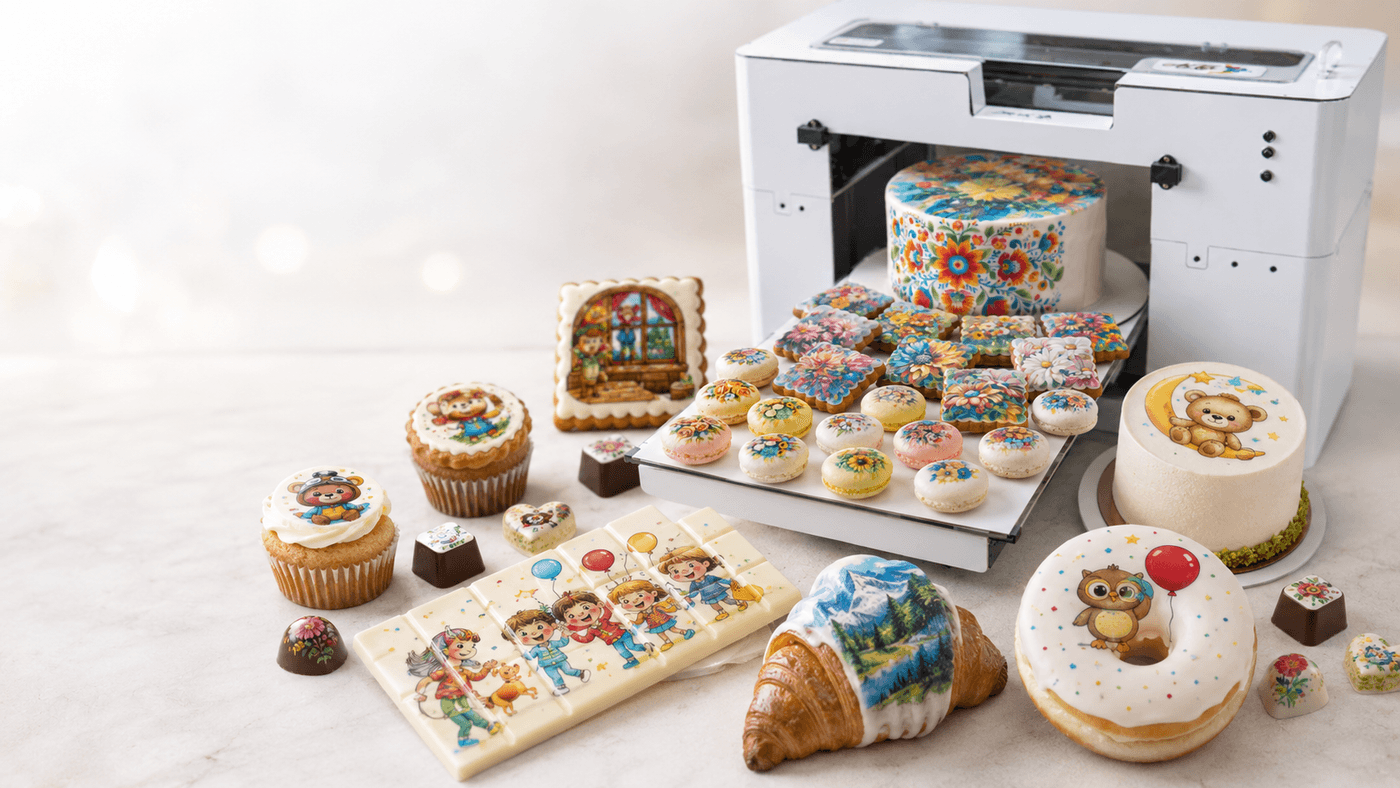
Why thermal inkjet confectionery printers beat piezo inkjet ones
Why we switched from piezo inkjet printing to thermal inkjet — and what it means for a confectioner in practice.
Today there are two most popular inkjet printing technologies:
- thermal inkjet — the ink is heated for an instant, forming a micro-bubble that pushes a droplet out through the nozzle (used in Canon and HP printers);
- piezo inkjet — the ink droplet is pushed out of the nozzle by the deformation of a piezo element (used in Epson and Brother printers).
We started out in 2018 with piezo inkjet printers (the E05 and E12 models), believing that piezo print heads were more reliable. However, when in 2020 we offered customers a printer based on thermal inkjet technology, we changed our minds.
It turned out that for direct printers on sweets, thermal inkjet printing has very serious advantages. As a result, today we have completely abandoned desktop piezo inkjet confectionery printers.
What is wrong with piezo for a confectioner
Piezo inkjet technology is good for printing on paper, but for desktop direct printing on confectionery items, thermal inkjet printing has important advantages.
Advantages of thermal inkjet printing
- Higher speed. Printing is 30–50% faster — handy when you need to fulfil an urgent order or produce a large batch of items for a holiday.
- High print quality. The high speed is achieved without sacrificing quality: a resolution of 4800 dots per inch with a droplet size of 1.5 picolitres produces perfect photos. The E15A3 model has a print quality of 9600 dots per inch.
- Not afraid of an uneven surface. A height variation of ±5–7 mm in the items is not a problem. This means that:
- you don’t have to calibrate gingerbread by height before printing — saving time;
- you can print on already-assembled macarons rather than on separate shells;
- you can print on items with an uneven surface — éclairs, croissants, doughnuts.
- Lets you print on chocolate. The droplet is heated inside the head, which improves ink adhesion — you can print on tempered chocolate without a primer first.
- No jerks during printing. The image lays down evenly, without stripes or shifts.
- Handles downtime calmly. With a few simple rules followed, even a long break won’t put the head out of order.
- More reliable. Fewer quirks in daily work: the system gets airlocked less often and the heads clog less often. Separate print heads — colour and black (the C10 and C15N models). Servicing thermal inkjet printers is much simpler.
But! Everything said above applies only to desktop direct confectionery printers:
- if we are talking about a high-performance printer with a print width of 400 mm or more, piezo inkjet technology currently has no alternative here. Our E15NA2 conveyor-belt printer is fitted with 2 high-speed professional Epson piezo inkjet heads;
- if you need a printer only for printing on confectionery papers — we recommend looking at desktop piezo inkjet printers with a built-in CISS.
Our thermal inkjet models
Today the entire current ArTer range is thermal inkjet:
- Printer C10 — a reliable all-rounder, items up to 12 cm.
- Printer C15N — automatic, up to 15 cm.
- Printer C15WiFi — the same plus printing from a smartphone.
- Printer E15A3 — wide format 30×45 cm.
Not sure which suits you? Get in touch — we’ll help you choose.
We'll help you choose a printer for your items and send you a special price.
Get the special offer